Updated on:
| Written by:
How a Strait of Hormuz Disruption Could Impact the Semiconductor Supply Chain
Key Takeaways
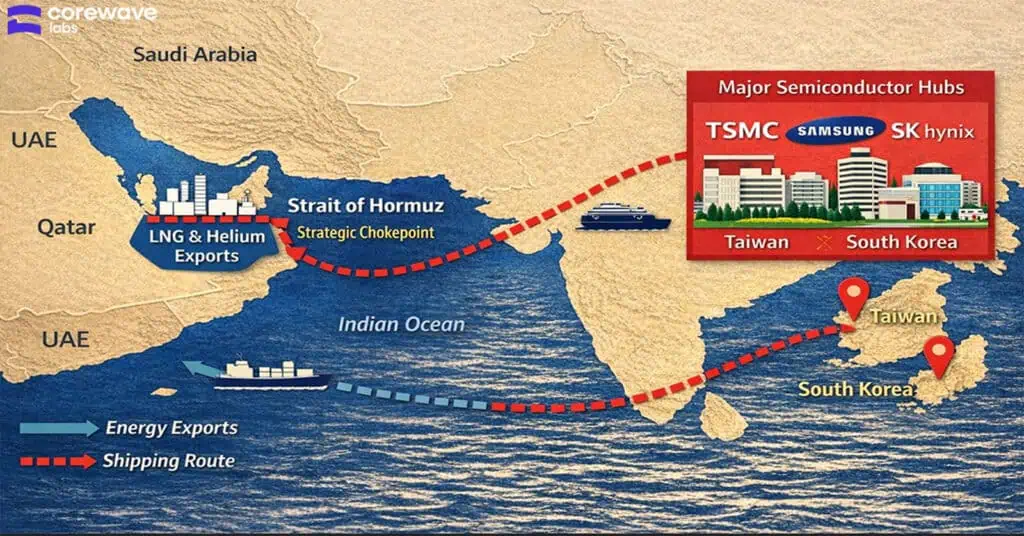
- The Strait of Hormuz carries energy and industrial gases critical to semiconductor fabs
- Taiwan generates 42–47% of its electricity from LNG, much of it imported via the Gulf
- Qatar supplies ~35% of global helium, a key input for semiconductor manufacturing
- Shipping disruptions could delay semiconductor materials by 2–3 weeks
- DRAM, NAND, and enterprise SSD markets could face additional price pressure
Introduction
Semiconductor supply chains depend on far more than advanced lithography. A narrow shipping corridor in the Middle East — the Strait of Hormuz — quietly carries energy and industrial gases essential to the world’s chip factories.
A disruption here would directly affect semiconductor production. Major fabs operated by TSMC, Samsung Electronics, and SK Hynix rely on uninterrupted power, specialized gases, and complex global logistics to keep their facilities running 24/7.
This risk becomes even more relevant considering that the memory market was already tightening. As discussed in our earlier analysis — DRAM Price Increase: DDR4 and DDR5 Server Memory Outlook for 2026 — server memory prices have been on a parabolic upward trend since mid-2025 due to supply constraints and strong AI infrastructure demand. A geopolitical disruption affecting energy, materials, or shipping could further amplify volatility across the semiconductor supply chain.
1. Energy Vulnerability of Asian Chip Fabs

Modern semiconductor fabrication plants are among the most energy-intensive manufacturing facilities in the world. Advanced fabs operate 24 hours a day, running thousands of tools that require perfectly stable electricity for lithography, deposition, and wafer processing. Even brief power interruptions can damage wafers worth millions of dollars per batch and halt production for extended periods.
In Taiwan and South Korea, a large share of electricity is generated using liquefied natural gas (LNG). In Taiwan, LNG accounts for around 42–47% of total electricity generation, making it the backbone of the island’s power system and creating a direct link between global energy shipping routes and semiconductor manufacturing..
Taiwan imports nearly all of its energy, and about one-third of its LNG supply comes from Qatar, with broader Middle Eastern suppliers accounting for roughly 37% of the fuel used to power the grid. Much of this energy normally passes through the Strait of Hormuz.
The dependence matters because Taiwan hosts TSMC, the world’s leading advanced chip manufacturer. TSMC alone consumes around 9% of Taiwan’s total electricity, highlighting how tightly semiconductor production is linked to national energy supply.
South Korea faces a similar structural exposure. The country imports nearly all of its natural gas to power industrial infrastructure, including the semiconductor campuses of Samsung Electronics and SK Hynix.
When energy supply routes become uncertain, electricity prices and supply security quickly become strategic concerns for semiconductor manufacturing. For an industry that depends on uninterrupted power and operates on extremely tight production schedules, even modest disruptions can ripple across global chip supply.
2. Helium and Bromine Supply Risks
Semiconductor manufacturing also depends on a range of specialized industrial gases and chemicals, many of which have highly concentrated global supply chains. Two materials that illustrate this vulnerability are helium and bromine.
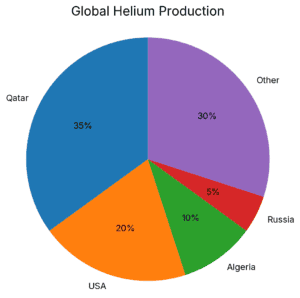
Helium plays an essential role in semiconductor fabrication. It is used in cooling systems for advanced manufacturing equipment and in several wafer processing steps, including etching and deposition. The semiconductor industry accounts for roughly 24–30% of global helium demand, making it one of the largest industrial consumers. A major share of global helium production comes from Qatar, which supplies around 35% of the world’s helium, meaning disruptions to Gulf exports can quickly tighten supply and push prices higher.
Another important input is bromine, used in semiconductor chemical manufacturing and in the production of materials required for electronics components. Supply is also geographically concentrated. For example, South Korea imports about 97.5% of its bromine from the Dead Sea region, highlighting how dependent semiconductor ecosystems can be on specific geographic sources.
Because these materials have limited short-term substitutes and complex production processes, supply disruptions can quickly translate into production constraints. For advanced semiconductor nodes used in AI infrastructure, data centers, and high-performance computing, stable access to these specialized materials remains critical to maintaining fabrication capacity.
Semiconductor fabs typically maintain less than three months of helium inventory. If supply from Qatar were interrupted for an extended period, manufacturers could face immediate production constraints once existing reserves are depleted.
3. Shipping Disruptions and Supply Chain Delays

Beyond energy and materials, semiconductor supply chains also depend on highly synchronized global logistics. The Strait of Hormuz is one of the key maritime corridors connecting Middle Eastern energy and industrial materials with manufacturing hubs in Asia.
When traffic through the strait becomes constrained, shipping capacity can decline sharply as vessels delay departures, wait for security clearance, or reroute to alternative paths. In practice, many shipments are forced to bypass the region entirely.
The most common alternative route runs around the Cape of Good Hope in southern Africa, which can add up to two to three weeks of additional transit time depending on the origin and destination. Longer voyages also increase fuel consumption, insurance premiums, and vessel operating costs.
For the semiconductor industry, these delays can affect multiple parts of the supply chain. Critical inputs such as specialty chemicals, industrial gases, and manufacturing materials may arrive later than planned. At the same time, semiconductor equipment, replacement parts, and wafer shipments can face similar delays.
Because semiconductor manufacturing relies on precisely timed deliveries across a complex global network, longer transit times and higher logistics costs can gradually push up production expenses and reduce supply flexibility across the broader chip ecosystem.
4. Impact on DRAM, NAND and Enterprise Storage
Disruptions affecting energy, materials, and logistics would ultimately flow through to the memory and storage markets, which are already highly sensitive to supply imbalances. DRAM and NAND production relies on complex global supply chains for wafers, chemicals, equipment, and energy. Any constraint in these inputs can quickly tighten supply across the ecosystem.
For DRAM, reduced fab output or higher production costs could further pressure supply chains already experiencing strong demand from AI servers and data center infrastructure. Manufacturers such as Micron Technology play a key role in global memory supply, and any broader disruption affecting semiconductor manufacturing regions would influence pricing and availability across the DRAM market.
The NAND and enterprise storage segment would face similar pressures. Companies such as Solidigm and Kioxia depend on stable semiconductor supply chains for NAND production and SSD manufacturing.
If energy costs rise, materials become scarce, or shipping delays extend production cycles, the effects would likely appear in higher prices for DRAM, NAND flash, and enterprise SSDs. These increases would ripple further into the infrastructure stack, raising costs for AI accelerators, high-performance computing systems, and data center storage deployments.
With AI infrastructure driving unprecedented demand for high-capacity DRAM and enterprise SSDs, even modest disruptions in semiconductor supply chains can quickly amplify price volatility.
Conclusion
The semiconductor industry is often associated with advanced technology and complex manufacturing processes, but it remains deeply dependent on global energy flows, specialized materials, and reliable shipping routes. Geopolitical chokepoints such as the Strait of Hormuz demonstrate how disruptions in one region can ripple quickly across the semiconductor ecosystem.
Energy supply interruptions, shortages of critical industrial gases, and longer shipping routes can all affect semiconductor production timelines and costs. Because modern chip manufacturing operates with highly synchronized supply chains, even moderate disruptions can influence output, pricing, and availability of key components such as DRAM, NAND, and enterprise storage.
For the industry, these risks reinforce the importance of supply chain diversification and regional manufacturing capacity. Governments and semiconductor companies are increasingly investing in new fabrication facilities and supply networks across multiple regions to reduce exposure to single points of failure.
While global semiconductor supply chains will remain interconnected, the events surrounding major maritime chokepoints highlight a growing strategic priority: building a more resilient semiconductor ecosystem capable of withstanding geopolitical and logistical shocks.
These vulnerabilities are one reason governments in the United States, Europe, and Asia are investing heavily in regional semiconductor manufacturing and supply chain resilience.
In an industry built on nanometer precision, even a narrow shipping corridor thousands of kilometers away can reshape the global semiconductor market.
FAQ
1. Why does the Strait of Hormuz matter for the semiconductor industry?
The Strait of Hormuz is a key route for LNG, helium, and petrochemical exports that support semiconductor manufacturing and energy supply for Asian fabs.
2. How could a Strait of Hormuz disruption affect semiconductor production?
Disruptions could increase energy costs, delay critical materials, and reduce fab output, tightening global semiconductor supply.
3. Why is helium important for semiconductor manufacturing?
Helium is used for cooling and wafer processing in semiconductor fabs. Qatar supplies about one-third of global helium production.
4. Why are DDR5 RDIMM prCould disruptions in the Strait of Hormuz affect DRAM and NAND prices?
Yes. Supply disruptions could increase production costs and contribute to higher DRAM, NAND, and enterprise SSD prices.
CoreWave DRAM & SSD Market Intelligence
Weekly pricing levels, stock quantities & EU/global availability on DDR4/DDR5 and Enterprise SSDs.
About the Author

Edgars Zukovskis
Board Member | CoreWave Labs
14+ years of expertise helping telecom operators, datacenters, and system integrators build efficient, cost-effective networks using compatible hardware solutions.
Recommended Reads
Discover insights to power your infrastructure.
Single Rank vs Dual Rank vs Quad Rank vs Octa Rank – Memory Rank Types Explained
ECC vs Non-ECC Memory: Differences, Use Cases & Benefits