Why RAM and SSD Prices Are Still Rising in 2026: Q3 Recap and Q4 Outlook for Server Buyers
- Memory contract prices rose close to 20% quarter on quarter in Q3 2026, according to Bernstein. TrendForce’s own Q3 figures were 13–18% for DRAM and 10–15% for NAND
- The pace is slowing, not reversing. TrendForce expects DRAM contract prices up another 10–15% and NAND up 15–20% in Q4. Q2 saw increases of roughly 60%
- Enterprise SSD is the one segment where price growth is accelerating in Q4. Enterprise SSD bit demand is forecast to grow more than 80% in 2026
- Samsung’s Q3 operating profit is expected at 106.1 trillion won, about nine times last year’s figure, yet its memory margin is forecast flat at 76%. Long-term agreements with price ceilings and a stronger won are capping the upside
- Bernstein expects prices to keep rising into 2027 and only normalise gradually from the second half of 2027 into 2028
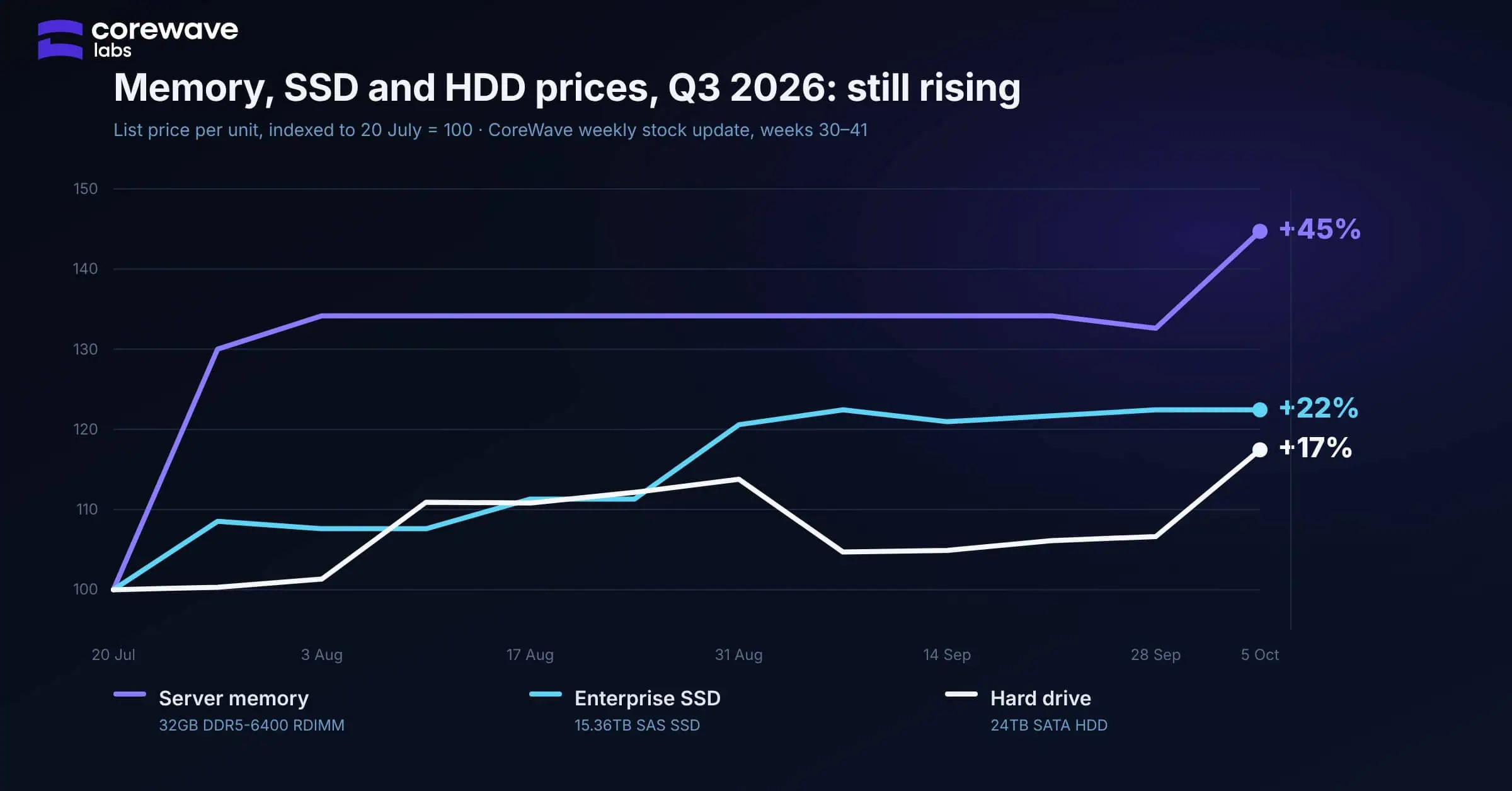
- On CoreWave’s own pricelist, 32GB and 64GB DDR5-6400 RDIMMs rose 20–45% between late July and early October. Enterprise SSDs rose 10–22%; QLC drives and 256GB modules lagged. Hard drives of 22TB and above rose 8–23%
- For buyers: lock volume on the SKUs you know you need, keep DDR4 exit risk on the radar, and use QLC where capacity matters more than endurance
Server memory prices have now risen for four consecutive quarters. In February we wrote that no meaningful relief was likely before 2027. Eight months later, that still holds. What has changed is the shape of the curve: the jumps are getting smaller, the gap between product classes is getting wider, and the first signs of a ceiling are visible in the suppliers’ own numbers.
This article covers what happened in Q3 2026, what TrendForce and Bernstein expect for Q4 and 2027, what we see in our own pricelist, and what a procurement team should do with that information.
Q3 in Numbers
Two sources published Q3 figures in the same week. They agree on direction and differ on magnitude.
| Source | DRAM, Q3 2026 QoQ | NAND, Q3 2026 QoQ | Note |
|---|---|---|---|
| TrendForce (3 July forecast) | +13–18% | +10–15% | Conventional DRAM; server DRAM at the strong end, tempered by long-term agreements |
| Bernstein (7 October) | close to 20% combined | Gain narrower than Q2 but strong by historical standards | |
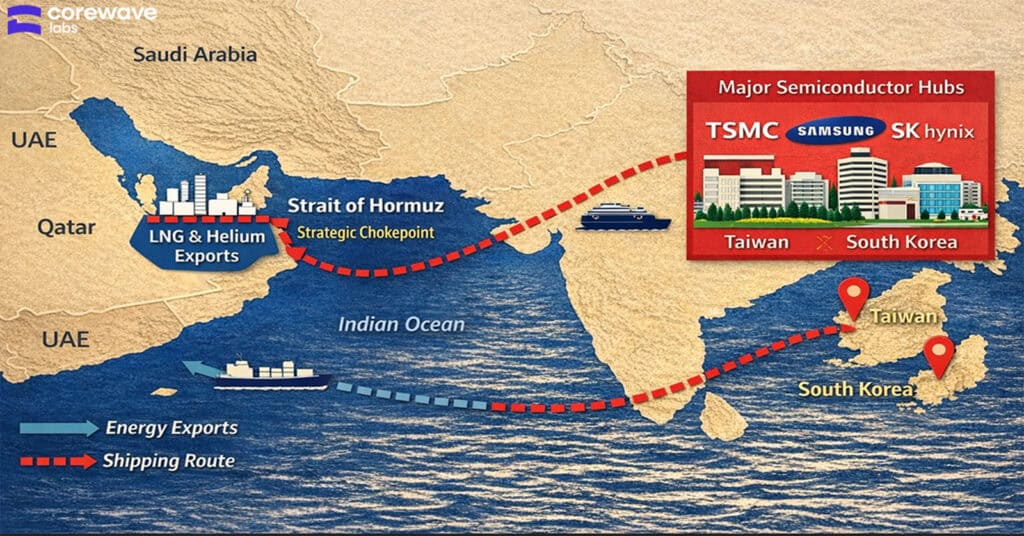
Both agree on the cause: AI server demand is absorbing capacity faster than the three DRAM makers can add it. Samsung, SK hynix and Micron are moving wafers to HBM and server DDR5, where margins are highest. PC, mobile and consumer SSD get what is left.
The number that matters for context is Q2. TrendForce’s Avril Wu, quoted by Reuters, put the Q2 DRAM contract increase at roughly 60%. Against that, 13–18% in Q3 is a slowdown. It is still a large number for a single quarter.
Why Samsung’s Margin Is Flat While Prices Rise
Samsung reports Q3 guidance this month. Analysts polled by Reuters expect operating profit of 106.1 trillion won (about $79 billion), roughly nine times the 12.17 trillion won of Q3 2025 and the fourth record quarter in a row.
The interesting figure is the one underneath. Samsung’s memory operating margin is forecast at 76%, the same as Q2. Prices went up, but the margin did not. Three things explain that:
For a buyer, the message is this: the largest customers have already fixed their prices. The spot and short-term contract market, where most integrators and resellers buy, is where the increases land in full.
What We See in Our Own Pricelist
Our own pricelist gives a second view of the same market, one SKU at a time. Here is how list prices moved between 20 July and 5 October, eleven weeks that cover most of Q3 and the first days of Q4. All figures are list prices in USD and change with availability.
| Module | Late July | Early October | Change |
|---|---|---|---|
| 32GB DDR5-6400 RDIMM 1Rx4 (Samsung M321R4GA0EB2-CCP) | $1,413 | $2,045 | +45% |
| 64GB DDR5-6400 RDIMM 2Rx4 (Micron MTC40F2046S1RC64BH1) | $2,390 | $3,239 | +36% |
| 64GB DDR5-6400 RDIMM 2Rx4 (Kingston KSM64R52BD4-64MD) | $2,439 | $2,934 | +20% |
| 128GB DDR5-5600 RDIMM 2Rx4 (Micron MTC40F2047S1RC56BR) | $4,130 | $5,723 | +39% |
| 32GB DDR5-5600 ECC UDIMM (SK hynix HMCG88AGBEA081N) | $1,284 | $1,936 | +51% |
| 32GB DDR5-4800 ECC SODIMM (Samsung M426R4GA3BB0-CQK) | $391 | $849 | +117% |
| 64GB DDR4-2933 RDIMM (Samsung M393A8G40AB2-CVF) | $630 | $804 | +28% |
Three things stand out. The mainstream server parts, 32GB and 64GB DDR5-6400 RDIMMs, rose 20–45% in eleven weeks, in line with or above the quarterly figures TrendForce reports for the contract market. Small-form-factor and workstation memory (ECC UDIMM, ECC SODIMM) rose even more, because those parts are built on the same die as server memory and get the leftover capacity. And DDR4 is not escaping: the 64GB DDR4-2933 RDIMM that stayed flat for most of the summer jumped 28% in September, exactly the pattern TrendForce describes as leading suppliers cut DDR4 output.
The one soft spot was very high density. The 256GB DDR5-6400 RDIMM peaked at $11,965 in mid-September and fell back to $10,226 by early October, still 4.5% above July. The number of buyers who need 256GB per slot is small, and at this price they are hesitating.
| Drive | Late July | Early October | Change |
|---|---|---|---|
| 15.36TB PCIe 4.0 TLC (Micron 7600 PRO) | $9,371 | $11,261 | +20% |
| 7.68TB PCIe 4.0 TLC (Micron 7600 PRO) | $4,045 | $4,747 | +17% |
| 15.36TB SAS TLC (Samsung PM1653) | $5,859 | $7,174 | +22% |
| 7.68TB PCIe 5.0 TLC (Kingston DC3000ME) | $3,982 | $4,708 | +18% |
| 3.84TB SATA (Kingston DC600ME) | $2,169 | $2,616 | +21% |
| 3.84TB PCIe 4.0 TLC (Solidigm D7-P5520) | $1,630 | $1,793 | +10% |
Mainstream TLC drives rose 10–22%, with the brands under the tightest allocation at the top of that range, matching the NAND contract increases. QLC capacity drives lagged, because 2025 inventory is still working through the channel. That gap is closing: the October price updates we received from distribution put Solidigm up 5% across the board, Kioxia up about 5% on selected models and Micron guiding to 15–28% increases through Q4, delivered as several smaller steps rather than one jump.
| Drive | Late July | Early October | Change |
|---|---|---|---|
| 28TB SATA (Seagate Exos ST28000NM003K) | $1,162 | $1,337 | +15% |
| 24TB SAS (Seagate Exos ST24000NM005H) | $1,140 | $1,404 | +23% |
| 24TB SATA (Toshiba MG11ACA24TE) | $980 | $1,151 | +17% |
| 24TB SAS (WD Ultrastar WUH722424AL5204) | $1,098 | $1,198 | +9% |
| 22TB SATA (WD Ultrastar WUH722222ALE6L4) | $957 | $1,040 | +9% |
| 22TB SAS (Toshiba MG10SFA22TE) | $887 | $955 | +8% |
The top of the capacity range, 22TB to 28TB, rose 8–23% while 16TB to 20TB drives were flat over the same period, as AI cold storage pulls demand to the largest drives. The October distributor updates point the same way: Seagate Exos and SkyHawk high-capacity models up 4–5%, Toshiba up about 5%, WD Purple up 15–20% and WD Ultrastar high-capacity models up 20–30%, and a further Seagate and WD revision was flagged for the first week of October.
Current prices for all of these are on our Pricelist.
Q4 2026 and 2027: Where Each Product Class Is Heading
TrendForce’s 30 September forecast is the most detailed public view of Q4.
| Product class | Q4 2026 contract price (TrendForce) | What is driving it |
|---|---|---|
| Conventional DRAM (all) | +10–15% QoQ | Suppliers prioritising advanced-node capacity for servers; market stays undersupplied |
| Server DDR5 RDIMM | Undersupplied; at the strong end of the DRAM range | CPU availability improving, so OEMs and cloud providers are buying more RDIMM bits |
| PC DRAM | Rising | OEMs buying ahead of a tight 2027 despite weak PC sales |
| DDR4 | Rising, no separate figure | Leading suppliers cutting DDR4 output; Taiwanese capacity expansion cannot offset it |
| NAND flash (all) | +15–20% QoQ | AI demand accelerating while consumer demand stays weak |
| Enterprise SSD | Accelerating; the only class growing faster than in Q3 | Bit demand up more than 80% in 2026 on AI inference and agentic AI deployments |
| Client SSD | Constrained increases | OEM inventories full; mainstream PCs shipping with smaller SSDs |
| HBM | Not covered in the Q4 note | TrendForce separately projects blended HBM prices up more than 100% in 2027 |
The enterprise SSD line deserves attention. In every other category the rate of increase is slowing. In enterprise SSD it is speeding up, because hyperscalers are building out inference capacity and most of the incremental supply is already sold. If your 2027 plans include large NVMe deployments, Q4 is the time to fix prices.
When Does It Plateau?
Nobody in the public data gives a date. The two clearest statements:
What a Buyer Should Do Now
Frequently Asked Questions
Why is RAM so expensive right now?
Because the three DRAM manufacturers are allocating wafer capacity to HBM and server DDR5 for AI data centres, where margins are highest. Less capacity reaches PC, laptop and consumer memory, and server buyers compete with hyperscalers for the rest. TrendForce reports DRAM contract prices rose roughly 60% in Q2 2026 and a further 13–18% in Q3.
Will RAM prices come down in 2027?
Not early in the year. Bernstein expects prices to keep rising into 2027 and to normalise gradually from the second half of 2027 into 2028 as new capacity comes online. TrendForce describes decelerating growth rather than a decline.
Why are SSD prices going up too?
NAND flash capacity is also being redirected to enterprise and AI storage. TrendForce forecasts NAND contract prices up 15–20% in Q4 2026, with enterprise SSD the fastest-rising category because enterprise SSD bit demand is growing more than 80% this year.
Is DDR4 being discontinued?
Not formally, but the leading suppliers are cutting DDR4 output to free capacity for DDR5 and HBM. Taiwanese manufacturers are expanding DDR4 production, but TrendForce says that does not offset the cuts. Expect DDR4 to stay expensive and harder to source through 2027.
Should I buy server memory now or wait?
If you have a confirmed project in the next two quarters, buy now or fix a price with your supplier. Both TrendForce and Bernstein expect Q4 prices above Q3. Waiting only makes sense for purchases that can slip to late 2027.
What is an LTA and why does it matter to me?
A long-term agreement is a multi-quarter supply contract between a memory maker and a large customer, usually a hyperscaler or server OEM. Many include price ceilings. Those customers are partly insulated from current increases; buyers on the spot or short-term contract market are not.
Does the Samsung profit record mean supply will improve?
Not directly. Record profit reflects price, not volume. New fabs take two to three years to add meaningful capacity, which is why Bernstein’s normalisation window starts in the second half of 2027.
Conclusion
Q3 2026 was the quarter the memory cycle changed gear: still rising, but no longer accelerating, except in enterprise SSD. Samsung’s flat 76% margin on a nine-fold profit increase shows where the ceiling is forming: long-term contracts with the largest buyers. Everyone else buys on the market, and the market is still going up.
The practical response is unchanged from February. Secure the mainstream SKUs you need for the next two quarters, treat high-density and DDR4 as separate decisions, and confirm lead time before you commit.
CoreWave Labs supplies server memory, enterprise SSDs, hard drives and CPUs to trading companies, system integrators and data centres across Europe and beyond. Every part is checked for condition and date code before it ships.
Need pricing or availability for an upcoming project? Request a quote or see our current Pricelist.

Further Reading
Samsung’s 2026 Labour Dispute: Supply Chain Lessons for Memory and SSD Buyers
Samsung DDR5 RDIMM Part Number Decoder